Reutilización para una segunda vida: Caso práctico de reutilización renovada
El edificio original de 24'x64' fue construido por Modern Building Systems en 1996 para servir como guardería para el Northwest Regional Educational Service District (ESD) en Forest Grove, Oregón. En 2016, Modern Building Systems dejó de necesitar el edificio y lo donó a la sección local de Habitat for Humanity. Compraron y retiraron el edificio sin coste alguno para el ESD. Luego se transformó en una hermosa guardería recién renovada para que Family Nurturing Center ampliara sus servicios como campus satélite en Phoenix, Oregón. El edificio alberga ahora servicios de guardería para 28 niños y familias.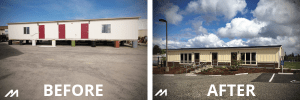
La nueva guardería consta de dos aulas, aseos para hombres y mujeres, una oficina y una cocina. Modern trabajó con Brian Westerhout, arquitecto y miembro de la junta directiva de Family Nurturing Center, para rediseñar el edificio y adaptarlo a las necesidades y deseos de la guardería. Se instalaron paredes adicionales cerca de los aseos y se amplió el pasillo entre las aulas para permitir una mayor accesibilidad. Las antiguas ventanas se sustituyeron por grandes ventanas de vinilo de alta calidad de 8/0 x 6/0 para que entrara más luz solar en las aulas. Las mejoras del suelo de marmoleum y de los muebles añaden un atractivo visual adicional a todo el edificio. Las nuevas características exteriores incluyen: colores brillantes personalizados de revestimiento de fibrocemento y adornos. También se han renovado el tejado y las puertas de metal hueco soldado.
Siempre que fue posible se utilizaron materiales del constructor original. Al utilizar la estructura original en la medida de lo posible, el resultado fue menos residuos de construcción y demolición en el vertedero. Básicamente, el cliente recicló todo un edificio modular. Para modernizar el edificio se instaló una unidad mecánica Bard de gas de alta eficiencia.
El Family Nurturing Center es una organización sin ánimo de lucro que forma parte de la respuesta innovadora e integral de Oregón para apoyar a niños y familias en crisis y, por lo tanto, funciona con presupuestos muy ajustados. Modern, en larga colaboración con contratistas locales, ofreció descuentos y donaciones para ayudar a hacer realidad este proyecto. Al utilizar un edificio usado y renovarlo, el cliente ahorró miles de dólares en comparación con un edificio nuevo con el mismo diseño y especificaciones.
Este artículo apareció originalmente en la revista Modular Advantage - Cuarto trimestre de 2018 publicada en noviembre de 2018.
Más de Modular Advantage
MBI Town Halls 2026: Reflections from Boston
By the end of 2026 MBI’s Government Affairs team will have traveled over 6,000 air miles to bring Town Hall events to five different cities in two countries.
Mind the Gap: The Interface Between Onsite and Offsite Construction
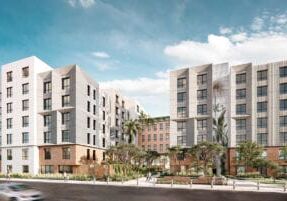
Every design for manufacture and assembly (DfMA) project — modular, mass timber, or panelized — is really two projects joined at a seam. One is built in a controlled factory to millimeter tolerances; the other in the field, in weather, to the looser tolerances of poured concrete and human hands. Between them sits an interface: where the factory’s precision meets the site’s reality.
Rules, Rails & Repeatability: Applying DfMA to Modular Healthcare
DfMA offers several advantages for healthcare projects, with faster delivery among the most valuable. Schedule matters when building new facilities, expanding campuses, renovating existing space or bringing care closer to communities that need it.
Precision and Possibility: Demands of DfMA and What Modular Mass Timber Makes Possible
Mass timber does not automatically create an efficient modular building. Its precision makes early coordination more important: fabricated components will accurately reproduce both the team’s solutions and its mistakes. The material’s advantages are realized only when supported by an equally precise design and delivery process.
Catch It in the Factory, Not in the Field: Smarter Testing for Modular Builds
Integrating watertightness and airtightness testing into factory workflows transforms quality assurance from a reactive process into a proactive commissioning strategy. It ensures that every module shipped is field ready and resilient for transportation while also supporting the ability of the modular construction industry to make buildings better.
Modular Construction Contracts: Key Considerations for Successful Canadian Projects
Starting a modular project with a well-developed contract protects both the owner and the contractor. It will help keep the project on track and on budget, and it will improve quality from the factory floor to final installation on-site.
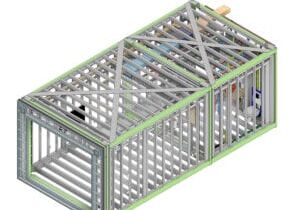
Modular by Design: Turning Architecture into a Manufacturing System
Modular construction is often presented as a faster way to build. Speed, however, is only one part of its value. The larger opportunity is to create a coordinated design and production system that improves quality, reduces uncertainty, and allows a building to move efficiently from concept design through manufacturing, transportation, installation, and completion.
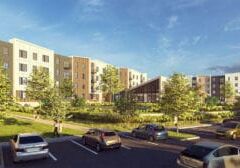
Repeatability Begins with Trust: What Alora at Dry Creek Reveals About Scaling Modular Housing
Alora at Dry Creek, a 329-unit, multifamily community comprising five four-story buildings in Centennial, Colorado, demonstrates how repeatable design, standardized manufacturing and early collaboration can work together to create a model that is not only faster to deliver, but easier to replicate across future projects.

T.R. Arnold: The Art of Third-Party Inspections
T.R. Arnold (TRA), a third-party inspection company in Elkhart, Indiana, contracts with modular manufacturers across the US. Manufacturers register with each state to which they intend to send their modules and may be required to hire a third-party inspection company.
Creating an ‘Ecosystem for Innovation:’ 50+ Years of Modular Construction Oversight in Virginia
Virginia’s modular building program began in 1973, with the implementation of the Virginia Industrialized Building Unit and Mobile Home Safety Regulations. Now it’s leading the country in modular code adoption.