
By-Right Permitting: The Missing Lever for Scaling Modular Multifamily

Ben Weagraff is the Head of Business Development at Knetyc
The modular building industry has spent a decade winning the manufacturing argument. Factory-built construction is faster, safer, and more predictable than stick-built. Yet across much of the country, modular multifamily projects still stall in the same place traditional construction does, with the entitlements. If our industry wants to scale beyond pilot projects and boutique developments, it needs to solve for permitting with the same rigor it has applied to the factory floor.
That's where by-right permitting comes in. And it may just be the most underused lever available to modular developers today.

Miro Apartments, designed by DJR Architecture and built by RISE Modular.
What "By-Right" Actually Means
A by-right project is one that complies with existing zoning and building code so completely that it doesn't require a discretionary approval — no variance, no conditional use permit, no design review hearing where a planning commission votes on whether your project gets to exist. If the plans meet the code, the jurisdiction is obligated to issue the permit.
For most developers, this sounds obvious. In practice, it's rare. Zoning codes are dense, jurisdiction-specific, and frequently contradictory between what's written and what's actually enforced. Discretionary review has become the default path for almost any multifamily project of scale, which means timelines are set not by construction schedules but by hearing calendars, staff turnover, and local politics.
Uniformity Unlocks Entitlement Risk
Stick-built construction struggles to be reliably by-right for a simple reason, every project is custom. Even two buildings from the same architect vary once site conditions, subcontractors, and value engineering enter the picture, so a jurisdiction can't fully trust a one-time compliance check because no two projects are actually the same. That's a large part of why discretionary review became the default in the first place.
Modular inverts that logic. A manufactured product is, by definition, uniform — the same unit, built the same way, batch after batch. A manufacturer can engineer a product once against a fixed set of by-right conditions — setbacks, height, density, materials — and every unit that comes off the line afterward already satisfies them. It is important to understand that even within modular construction, manufacturers are still able to customize the unit to customer-specifics to some degree.
One-off stick-built design has to evaluate each specific project on its own terms. A planning department reviewing a modular product that's already been engineered to a known, repeatable by-right specification is merely confirming. The review essentially boils down to "does this match the spec we already approved?" That's a dramatically lighter lift for city staff, and faster to process, harder to contest, and easier to scale across many projects without adding headcount. Uniformity is what makes by-right scalable, for the jurisdiction as much as for the builder.

Larkspur Apartments, designed by EVstudio and built by Fading West Building Systems and Symmetry Builders.
The Lesson is to ‘Design for the Code’
The developers having the most success with by-right modular multifamily share a common practice: they treat zoning compliance as a design input from day one. That means auditing local code before designing the product including such things as setbacks, height limits, density, and parking ratios. If we consider by-right a path forward for modular, we can imagine a scenario where developers work in concert with the modular manufacturers to dramatically lessen the entitlement risk for the whole project. It doesn't generate the same excitement as a factory tour or a time-lapse of modules being craned into place. But it's the work that determines whether a project takes nine months or two years to reach groundbreaking.
Why This Matters for the Missing Middle
Nowhere is this more consequential than in missing-middle multifamily, including the duplexes, fourplexes, and small-scale apartment buildings that used to be a normal part of how American cities grew, and that have largely disappeared from new construction over the past several decades. These are precisely the project types where discretionary review adds the most relative delay and cost, because margins are thinner and entitlement timelines often exceed construction timelines several times over.
Modular's core value proposition of speed, cost predictability, and quality control is largely neutralized if a project spends a year and a half waiting on a hearing date. By-right permitting is what lets modular's manufacturing advantages actually reach the balance sheet. It's the difference between modular being a novelty for well-capitalized developers who can absorb entitlement risk, and modular becoming a repeatable model for the mid-market developers who build most of the country's housing.

West Holden Place, a multifamily affordable housing project developed by Adam Berger Development and built by Nashua Builders.
Designing for Entitlements Creates a New Engagement With Each City
At Knetyc, we approached this as a matching problem. Our platform takes a modular builder's design specifications and compares them against the zoning and building codes of individual jurisdictions to identify exactly where that product is already by-right compliant as designed. The question "where can we build this today, with no discretionary review" becomes something closer to a site-selection tool.
The bigger lesson, though, isn't about our particular product — it's that by-right permitting deserves far more attention as a deliberate housing-supply strategy than it currently gets. In an America challenged with housing scarcity, many cities have not yet considered by-right as a path to housing supply. Where by-right pathways exist for multifamily, they tend to be a byproduct of how a code happens to be written. Cities already treat density bonuses and parking minimums as policy dials they adjust to shape development outcomes. By-right thresholds for standardized, modular construction types deserve the same deliberate treatment, not just because it unlocks supply, but because it's genuinely less work for the people reviewing it.
The Path Forward
Modular has already proven it can outperform traditional building methods on speed and cost per unit. The next frontier is outside the factory in the front end of the process, where projects either clear a path to construction or get stuck in review. Manufacturers need to design with entitlement thresholds in mind. Developers need to prioritize by-right-eligible sites and product types. And local officials have an underused tool sitting in their own code books, which after being engineered once, doesn't have to be re-approved, or re-evaluated, one project at a time.
Más de Modular Advantage
From Model to Machine: Why Modular Scale Is Becoming a Software Problem, not a Material One
For modular manufacturers that have already secured demand and repeatable volume, the next major constraint may no longer be forming capacity itself. Increasingly, it is the continuity of the information feeding that capacity.
Who Will Define Modular Products for AI?
Artificial intelligence is making building configurators easier and less expensive to create. This makes urgent manufacturers’ need portable product definitions, stable identities, and shared interfaces regardless of how others’ software is produced.
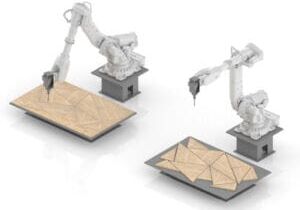
From BIM to Robotic Production: A Digital Workflow for Customized Components in Volumetric Modular Construction
For volumetric modular manufacturers, the value of this workflow is not simply the use of robotics. Its real value is continuity.
Helping Build a Common Framework for Modular Construction in Canada
Canada’s modular construction sector continues to gain momentum, but scaling it successfully will depend on shared expectations across design, manufacturing, approvals, and project delivery. CSA Z251 helps provide that common foundation.
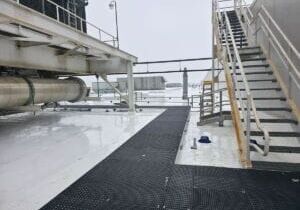
Edges, Exits & Equipment: A Modular Builder’s Guide to Rooftop Access
Rooftop access belongs in the factory design. Before the modules ship, the project team should identify each route’s users, confirm applicable requirements, coordinate with the roof system and structure, and assign responsibility.
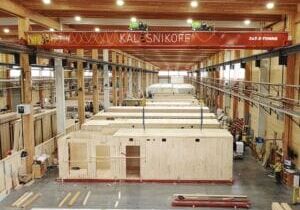
When Timber Production and Modular Construction Share One System
As demand for multifamily and workforce housing continues to outpace what conventional construction timelines can deliver, models that reduce the number of handoffs between structural fabrication and modular assembly are likely to draw more attention.
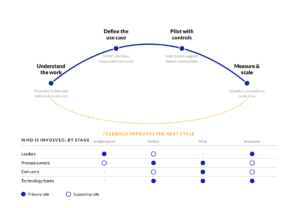
Your AI Strategy Is an Enablement Strategy
Tools will change. Teaching employees only the steps in one platform creates a narrow capability. Involving them in problem definition, process mapping, data assessment, controls, and measurement gives the organization a way to improve its systems as technology evolves.
Remote Inspections and The Future of Factory Oversight
Remote inspection is becoming a practical part of modular construction oversight. Its value is greatest when it is used selectively, governed by clear procedures, and supported by complete traceability.
Reimagining Dry-In: How a Temporary-to-Permanent Roofing Strategy Mitigates Risk Between Modular Installation and Final Roof Construction
As volumetric modular projects continue to increase in scale and complexity, the Temporary-to-Permanent FiberTite Roof System represents an example of how traditional trade scopes can be reimagined through Design for Manufacturing and Assembly (DfMA) principles.
The Robotic Advantage: Addressing Labor and Quality Challenges in Construction Finishing
The off-site industry has already moved construction from an unpredictable jobsite into a controlled manufacturing environment. The next evolution is to make that environment increasingly intelligent, adaptable and automated.