Modular Housing Policy in California: An Interview With Tyler Pullen of Terner Labs/UC Berkeley’s Terner Center for Housing Innovation
MBI Government Affairs Manager Andrew Muchnick sat down with Tyler Pullen at the 2026 World of Modular to discuss Terner Lab's work with the California state assembly related to offsite construction.
Andrew Muchnick: Tyler, thanks for joining me here at the 2026 World of Modular. I chatted with Jason Van Nest from New York Tech yesterday, and we had a really good conversation about the CfOC/ICC 1220 standard that's in the works. Like I said before, standardization is kind of my hobby horse. Before we get into that, can you give readers here an intro, insight and intro into who you are, what you do, what kind of work you do, all that kind of stuff.
Tyler Pullen: Sure. Hello. I'm Tyler Pullen. I work for Terner Labs and UC Berkeley's Terner Center for Housing Innovation. Pretty much everything I do operates at the intersection of building industry and housing industry, and especially a lot of work on housing policy. So most of that anchors to our accelerator program to support building industry innovators, often offsite construction focused companies, and then I've also led all of our research at Terner on all things building industry, which, as well, has focused a lot on offsite construction things and how industry and legislative and regulatory reform can better accommodate more innovative methods such as offsite construction.
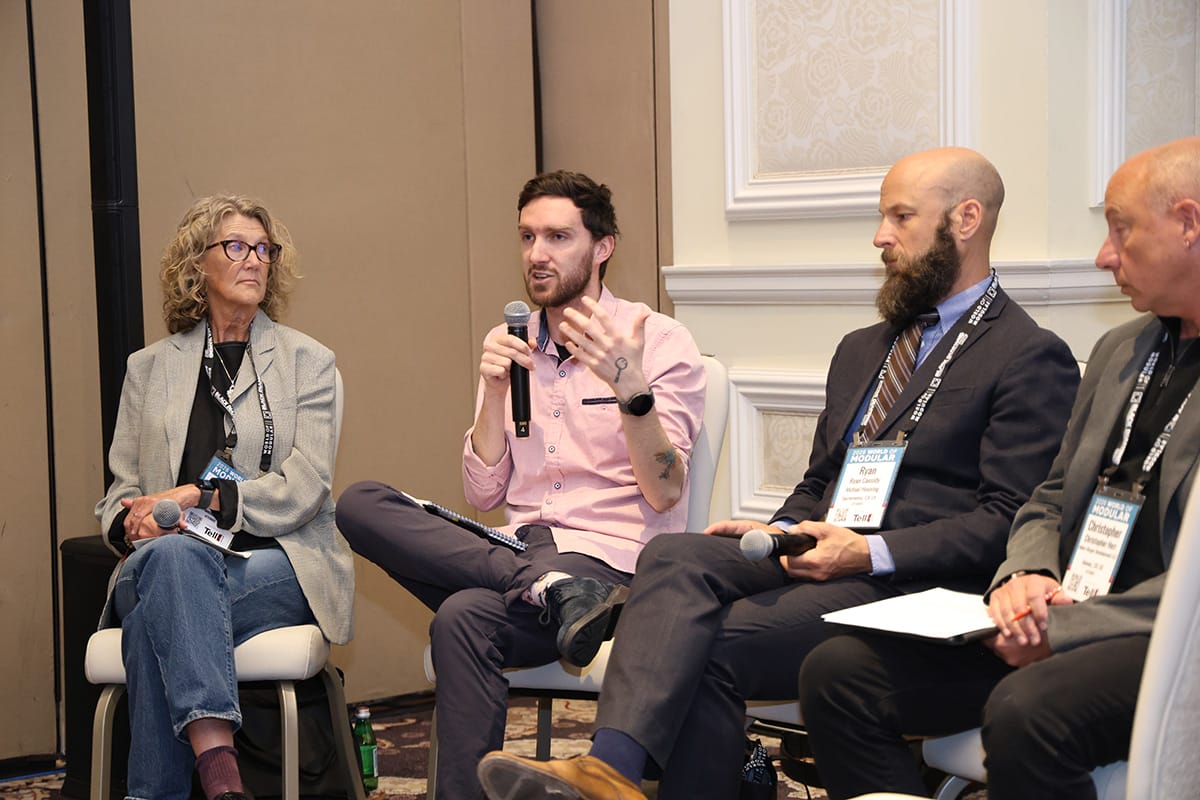
Tyler Pullen speaks at the 2026 World of Modular conference in Las Vegas.
AM: That's awesome. So, like you said, you're based in California. California is taking what we at MBI are calling a pretty “aggressive” approach to boosting the off-site industry, and housing in general. It is probably one of the more aggressive, concerted efforts in the entire country. Can you talk about the "Potential Pathways to Scale Innovative Construction Methods in California" report that you co-authored?
TP: Sure, for everything California is doing that might be aggressive, it's to combat the aggressively worse housing affordability crisis relative to other places as well. In that vein, we got reached out to by Assemblymember Buffy Wicks, so one of our state legislators and the two Congress-equivalent legislative bodies that we have at the state level. Buffy Wicks has been one of the biggest and most, since we're with the term aggressive, one of the most aggressive policymakers addressing housing reform at the state level in California for at least the last few years, if not longer.
A lot of that past work has focused on land use reform, and especially trying to speed up permitting and increase certainty and reduce timelines for entitlements and permitting and a lot of things related to zoning and local control, she came to us in, might have been August last year, basically saying that they've done a lot of good work on the land use reform and environmental review sort of content, and that construction costs are one of the next great bottlenecks to affordable housing and housing supply feasibility, generally across the state, with a lens towards construction innovation and other things to bring down that construction cost. So, her first outreach was mainly like, “is there a there? Is there actual state legislative and regulatory reform to address that?” And she walked into our inbox, and we have spent the last eight or so months frantically but rigorously informing that legislative process.
So, the white paper to finally get around to your actual question. The white paper was born out of their Buffy Wicks' and other of her Assembly Member colleagues, their sincere, earnest interest into understanding enough of the dynamics of building industry and offsite construction in particular, to make good legislation, both to identify what policy ideas are most politically and industry feasible, while also being high impact, and to get into the mechanics of specific policy design questions that they would not be able to answer otherwise. So, the white paper was a several-month concerted effort led by us and my colleagues at Terner Center. We gathered 67 different interviewees and workshop participants, reflecting a broad swath of the housing industry specifically focused on construction innovation. So, there were some factories and indeed some MBI members in those workshops, some developers, some lenders, some general contractors. We get to conduct that research to lay out, basically go beyond the level of detail that we typically end up at.
[An example would be] “building code harmonization would be helpful for the industry,” as identified by our interviewees, and [then] actually spend enough time with really smart people in the room to identify specifically what is the actual state lever, and what is even some of the specific type of bill language you would hope for to get the impact [from] building code standardization. That landed into the white paper report that was only published a couple months ago, it feels like two years ago already, that I think, laid out 40 or so specific policy ideas and laid out some of the dynamics that respondents discussed in terms of tradeoffs or potential impact or acute versus long term need and benefit.
And then in parallel, I swear this is the end, in parallel, the legislative select committee, like a special Advisory Committee on this topic, picked up seven or eight different bills that they ran with directly informed by the research we did, and while we were writing up the final report, and that have since become part of that bill package for supporting construction innovation across California, of some of those policy ideas we identified and got to discuss with our network.
AM: Yeah, that's awesome. That actually flows really well into my next question. You actually answered one question in the middle. So perfect. There's a lot up in the air about that package of bills, right? Some of them are still being amended. They're still in the works. Nothing's really decided yet. But are there one or two ideas that didn't make it into this year's package that you would have liked to have seen make it in and eventually implemented? And then why?
TP: I have the convenient preface of, “we're not allowed to advocate or lobby for any specific things,” so my answer will be personal. I think one of the things that came through pretty strongly in the research did not end up in a bill package, and remains of mostly open question, is that, like workforce integration and upskilling of workforce for both onsite incumbent construction industry labor, but also to define and accelerate like, what skills are needed to succeed in offsite construction in particular, and that's up and down the value chain, if we can call it that, of architects and systems and structural engineering designers and the actual people putting pieces together on the factory floor and then the equivalent of superintendents to organize some of the factory layout itself.
All of those skills are still gaps for a lot of factories that are upskilling or developing their own sort of training curriculums in house. And there's still a lot of friction or misunderstanding, or just lack of exposure, honestly, with how off site construction components translate into the on-site scopes and even basic mechanics of how to adjust bids and the extra level of detail that needs to go into scope, definition between on and off site work.
That came through super clearly as a really critical need, pretty much across everyone we talked to in the research. But it got hung up at the immediate next question of "what are the state levers for that?" And also, who within the state or even externally as part of the industry, can lead the effort to define what are those skill sets?” and sort of, "what is the relationship, long term for on versus off site work?" That's a big open question, generally, even outside of California.
So, I think it feels right, personally speaking, it feels right that there isn't a bill dedicated to that specifically, because there's just such open questions and not an obvious next step in the near term for that. I think that's one that is an active question on the brain of many and also, a significant portion of the housing affordability crisis and housing shortage generally, is related to the lack of skilled construction labor. That doesn't seem to be a problem that's getting solved anytime soon.
And, a lot of the pitch for off-site construction generally, is just to add capacity that we do not otherwise have, even independent of broad productivity metrics. We just need more humans involved in supplying housing and building, whether it's on site or off site. I think that remains to be true. So, I think there's a lot of work that's still needed to define and put a more substantive step in the direction of growing the workforce and better defining or aligning interests across on and off-site scopes of work. But there isn't anything in the current bill package, despite how clearly that came through that seems like maybe not a legislative or regulatory effort, but something that is on the minds of a lot of us, despite the momentum of the current bill package.
AM: I know MBI has, shameless plug, our own education and workforce development programs, and it does seem that it would be a difficult ask for legislators, other than to throw money at the problem which is always nice. You know, everybody likes getting money thrown at them, but that does seem like a really good opportunity for private sector, both from the corporate world and the academic world like yourself, to come together and sort of provide, again, to talk about standardization, off-the-shelf solutions for every level, like you said, all the way from the manufacturers for their labor force to educating the GCs and educating the financiers.
You know what I mean? It's one of those things where every segment of the cycle needs education, and it's not necessarily clear where assemblymembers and the legislature would come into that other than to give monetary support where it and then when it makes sense.
TP: Yeah. I think the only other big thing that comes together, which, with the full confession that, because we have been doing this research more close to the legislative process than we typically do, I personally am learning a lot about the exact details and pace of the legislative process, which is to say, stressed all the time. And one of the distinctions that's becoming slowly more clear to me is the difference between legislative action and regulatory action, where the former is what Buffy Wicks and team is focused on intuitively making new laws, where regulatory action does not necessarily need new laws. It's just independent, sometimes politically pressured decisions to existing state or other government agencies to change the terms and conditions or line item sort of detail edits in how they administer and enforce existing law, and one piece of it that is not necessarily legislative, that was identified pretty early by Buffy Wick's staff as a regulatory change that is nonetheless like I'm trying to keep top of mind, because it is so relevant and needed is: better mechanisms for data sharing across the industry.
And I know MBI keeps its project database that nonetheless has some holes. [But it is] understandable that it wouldn't be completely open-access or have all the details or offer perfectly standardized, robust evidence as to the cost and time outcomes of projects using factory-built housing components. And to quality questions, even basic metrics like how many punch list items were there on a given project is not anything the building industry is equipped to measure or publish itself.
And then it's doubly difficult when you're trying to compare to the status quo by doing something innovative and ostensibly better, and so different ways for the state or other entities to collect, clean and host different data to build the stronger evidence base and kind of dispel a lot of misconceptions or concerns that remain with pretty much everyone in the housing industry, from GCs and subs to developers, to lenders, to insurance companies, and everything in between.
I think the thing that's kind of hanging above, not in the legislation, but we're trying to keep top of that is “what better data access and sharing mechanisms can we have to really build a stronger base of evidence here?”
AM: Yeah, definitely. And I think that that's a good avenue for NGOs broadly, like Terner Center, like MBI and other trade associations and their members, to be able to find the data that's not market moving, you know, that's not proprietary, right?
TP: Selling something or directly invested, necessarily.
AM: It’s data that is hard to aggregate. I mean, I've talked to other academics and people here, and that's another thing that plays into the education question is, “you don't know what you don't know, and there's a lot we don't know.”
So, I want to wrap up here. I want to be conscious of time. We've been pretty California-centric so far, which makes sense given your background. But is there anything elsewhere in the country or in the world that's really piquing your interest in terms of innovative policy solutions related to offsite construction or modular specifically?
TP: Great question. So yes, this specific work we've been talking about is California-focused. Terner does have a nationwide focus, and different projects have different geographies. So, one of the things that's active and underway is we're basically seeing how well or how unwell the California Research we just did maps on to other states in terms of like basic market and industry landscape assessment. But also, like the specific policy ideas, are some of them useful in other states? Or are some of them redundant in other states that have more centralized code authority at the state level already, which is true for several states. So, we're doing a little bit of like trying to keep the momentum and keep the conversation going with other states.
I think one specific plug, since I definitely have a passion for international comparisons, on the premise that I think of the many things that don't translate well across national borders, including culture and governance structure and historical policy, trends and things and market conditions, I think a lot of the things around building industry and especially like offsite construction, can actually translate more neatly across borders, with a ton of caveats.
But I think there is a lot to learn across borders sometimes than different like international policy comparison pieces and one that I've been desperate to - I'm going to do two, since I think I can do them both shortly,- two that have been desperate to like deep dive further is one a lot of how EU handles its building code governance, and especially as that scales down from EU code, which mostly covers structural, to national codes, and how they handle building code harmonization and enforcement is just like a wildly interesting and untapped kind of research thing. I find that really fascinating and want to look into it further as it relates to offsite construction.
And then the even shorter one is a specific thread. Public Housing Sweden is kind of a consortium of a lot of local public housing authorities, and despite a lot of people's instinct to assume Sweden just does a lot of public subsidy and gives money to factories or projects, the local public housing authorities in Sweden are mostly run like businesses, meant to compete with private market actors in Sweden. And they have a sort of functionally working demand aggregation thing, where they have an open RFP every six years, I think, to select preferred vendors based on some basic performance like cost and time metrics, on a sort of template multifamily housing project.
This offers easier access to the local public housing authorities when they're choosing off-site manufacturers in particular, because they can meet time and cost metrics more definitively than stick-built construction. So, I've been wanting desperately to pour into the mechanics of that. And even though we don't have a lot of public housing development, really none at all in the US, and we don't really have a consortium of developers as an equivalent, I think there are interesting and relevant mechanics of demand aggregation and how other countries have done that. So Public Housing Sweden is ever more relevant as we continue to find different state and regional actors trying to do demand aggregation in different ways in the US.
AM: And look, that's my last question for now. I think I would love to set up a time to talk about just demand aggregation. It's hugely enormous topic. So hopefully we can get some time on the books later on, after we all come back from WOM, but I’d like to give you a minute if you want to plug anything else. But that's all the questions for me.
TP: Cool. Yeah. Just follow our website. I'm inactive on LinkedIn. People keep tagging me and the things going on are posted on the Terners' LinkedIn too, but yeah, follow our work from our newsletter for the most direct access. Terner Center for all the research outputs we have, and then Terner Labs for our work in closer concert with actual innovators in the industry and supporting their growth and highlighting interesting business models we find. And then last plug to you for teaching me that you can indeed say WOM.
AM: Tyler, thanks for your time. I really appreciate it.
About the Author: Andrew Muchnick is the government affairs manager for the Modular Building Institute. You can reach him directly at andrew@modular.org or on LinkedIn.
Otros artículos sobre asuntos gubernamentales
La Oficina del Gobernador de California colabora con MBI en una iniciativa de contenedores marítimos para personas sin hogar
La Oficina del Gobernador de California colabora con MBI en una iniciativa de contenedores marítimos para personas sin hogar El Director de Asuntos Gubernamentales de MBI, Jon Hannah-Spacagna, fue contactado...
Leer el artículo completoMBI colabora con el Departamento de Trabajo e Industrias de WA.
MBI colabora con el Departamento de Trabajo e Industria del Estado de Washington para adoptar la revisión de planes por terceros A finales de agosto,...
Leer el artículo completo
El Modular Building Institute protege a los miembros que operan en Nueva York
Modular Building Institute protege a los miembros que hacen negocios en Nueva York A principios de la sesión de la Legislatura del Estado de Nueva York de 2020, dos...
Leer el artículo completo
Desglosando el "Código de construcción modular"
MBI recibe a menudo llamadas de personas que preguntan: "¿qué es el código de construcción modular?". Así que vamos a responder a esa pregunta aquí.
Leer el artículo completo- " Anterior
- 1
- 2
- 3
- 4