Ramtech Building Systems - Campus escolar permanente
Este proyecto proporciona espacio para 24 aulas estándar que permitirán acoger hasta 528 alumnos más. El edificio cuenta con cinco aulas de uso especial para los programas de arte, música, logopedia y educación especial de la escuela. También incluye una cafetería con cocina de calentamiento, oficinas administrativas, biblioteca, centro de tutoría y laboratorio de aprendizaje, y una sala de ejercicios polivalente de 3.000 pies cuadrados con suelo deportivo y una altura de techo de 14 pies. Incorporamos una mezcla de mampostería y EFIS que complementaba las estructuras existentes y proporcionaba un aspecto cohesivo al campus. La selección de acabados interiores se basó en gran medida en el uso educativo e incluyó yeso pintado, baldosas elásticas y cerámicas, así como un falso techo acústico.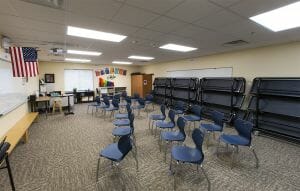
Ramtech desarrollado nuestro sistema de losa en el grado PMC como un medio eficaz para proporcionar pisos de concreto, mientras que tratar con los suelos altamente expansivos que se encuentran en todo Texas. Las instalaciones convencionales de PMC de pilares y vigas requieren una viga de nivelación o cimentación de muro de vástago soportado típicamente por pilares perforados. A continuación, un pilar de bloque convencional soporta un sistema de suelo modular de acero con una cubierta de acero corrugado y tres pulgadas de hormigón ligero vertido.
Esta redundancia de estructuras (gastos de cimentación y un sistema de suelo modular) añade un coste considerable al proyecto. Utilizando una losa de hormigón convencional vertida in situ, tal y como prescribe el ingeniero geotécnico, y colocando después un módulo sin suelo directamente encima de la losa, se consiguen tres cosas a un coste menor: mejor acústica del suelo gracias a una mayor masa (suelos silenciosos); se proporciona una entrada a nivel de rasante en todas las puertas exteriores; y no hay espacio de arrastre que ventilar, lo que reduce en gran medida la posibilidad de una mala calidad del aire interior.
This article originally appeared in the Modular Advantage Magazine - First Quarter 2018 released in February 2018.
Más de Modular Advantage
MBI Town Halls 2026: Reflections from Boston
By the end of 2026 MBI’s Government Affairs team will have traveled over 6,000 air miles to bring Town Hall events to five different cities in two countries.
Mind the Gap: The Interface Between Onsite and Offsite Construction
Every design for manufacture and assembly (DfMA) project — modular, mass timber, or panelized — is really two projects joined at a seam. One is built in a controlled factory to millimeter tolerances; the other in the field, in weather, to the looser tolerances of poured concrete and human hands. Between them sits an interface: where the factory’s precision meets the site’s reality.
Rules, Rails & Repeatability: Applying DfMA to Modular Healthcare
DfMA offers several advantages for healthcare projects, with faster delivery among the most valuable. Schedule matters when building new facilities, expanding campuses, renovating existing space or bringing care closer to communities that need it.
Precision and Possibility: Demands of DfMA and What Modular Mass Timber Makes Possible
Mass timber does not automatically create an efficient modular building. Its precision makes early coordination more important: fabricated components will accurately reproduce both the team’s solutions and its mistakes. The material’s advantages are realized only when supported by an equally precise design and delivery process.
Catch It in the Factory, Not in the Field: Smarter Testing for Modular Builds
Integrating watertightness and airtightness testing into factory workflows transforms quality assurance from a reactive process into a proactive commissioning strategy. It ensures that every module shipped is field ready and resilient for transportation while also supporting the ability of the modular construction industry to make buildings better.
Modular Construction Contracts: Key Considerations for Successful Canadian Projects
Starting a modular project with a well-developed contract protects both the owner and the contractor. It will help keep the project on track and on budget, and it will improve quality from the factory floor to final installation on-site.
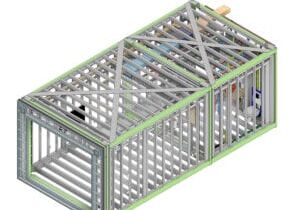
Modular by Design: Turning Architecture into a Manufacturing System
Modular construction is often presented as a faster way to build. Speed, however, is only one part of its value. The larger opportunity is to create a coordinated design and production system that improves quality, reduces uncertainty, and allows a building to move efficiently from concept design through manufacturing, transportation, installation, and completion.
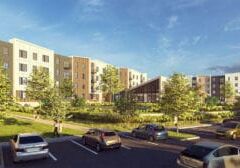
Repeatability Begins with Trust: What Alora at Dry Creek Reveals About Scaling Modular Housing
Alora at Dry Creek, a 329-unit, multifamily community comprising five four-story buildings in Centennial, Colorado, demonstrates how repeatable design, standardized manufacturing and early collaboration can work together to create a model that is not only faster to deliver, but easier to replicate across future projects.

T.R. Arnold: The Art of Third-Party Inspections
T.R. Arnold (TRA), a third-party inspection company in Elkhart, Indiana, contracts with modular manufacturers across the US. Manufacturers register with each state to which they intend to send their modules and may be required to hire a third-party inspection company.
Creating an ‘Ecosystem for Innovation:’ 50+ Years of Modular Construction Oversight in Virginia
Virginia’s modular building program began in 1973, with the implementation of the Virginia Industrialized Building Unit and Mobile Home Safety Regulations. Now it’s leading the country in modular code adoption.